
Why modern insurance transformations fail after Go-live (and how to avoid it)


Intro
Reaching go-live often feels like crossing the finish line.
The system is live.
The product is launched.
The press release is out.
But in insurance, go-live is rarely the moment success is decided.
In fact, many digital transformation projects fail after they have technically succeeded — three, six, or twelve months later.
Not because the platform was wrong.
Not because the idea was bad.
But because critical decisions were postponed — or never made at all.
The Go-Live illusion
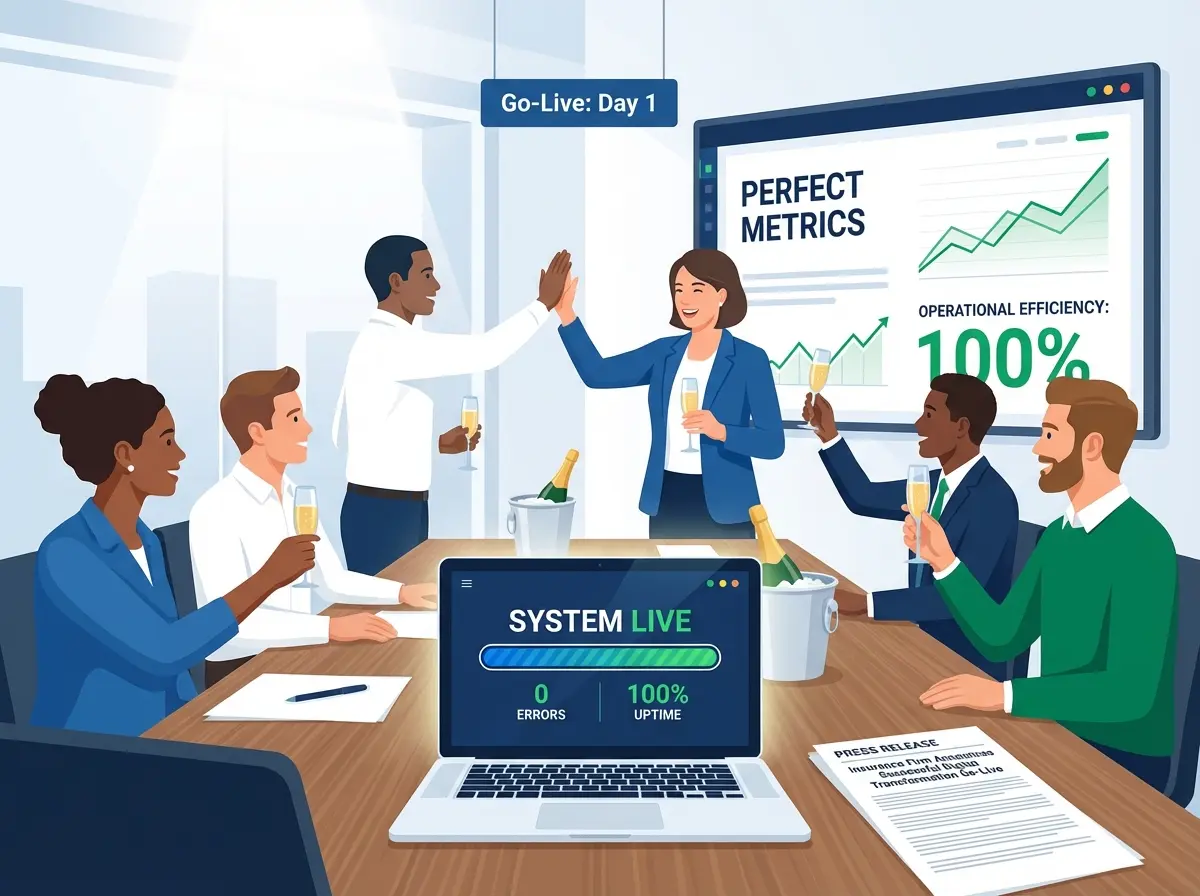
Most insurance transformations focus obsessively on getting to production.
Timelines.
Features.
Integrations.
Deadlines.
And that makes sense — reaching go-live is hard.
But here is the uncomfortable truth we keep seeing across Eastern Europe, MENA, and the Caucasus:
Many systems are built to launch — not to live.
They work at day-one volume.
They pass initial audits.
They handle the first wave of users.
Then reality catches up.
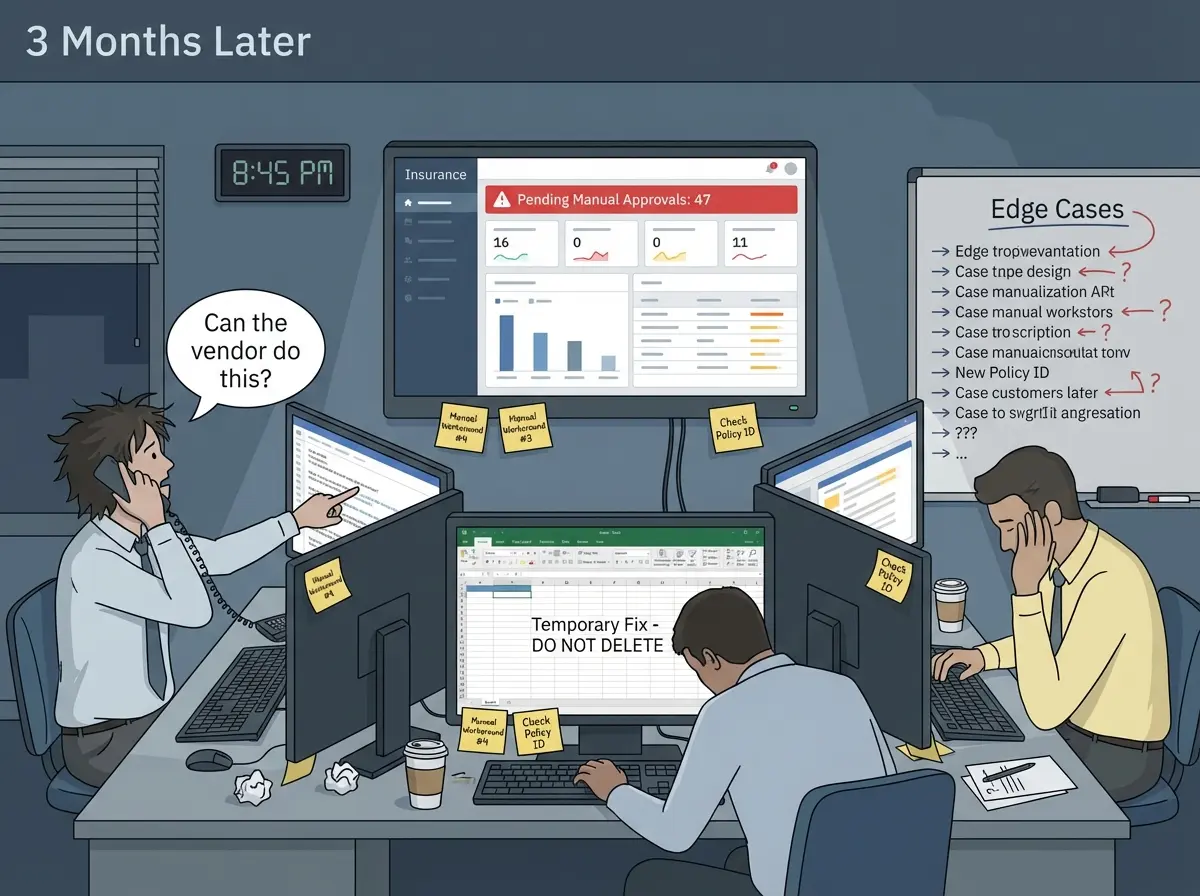
Three months in, edge cases start appearing.
Six months in, manual workarounds multiply.
Twelve months in, teams are exhausted — and the "new" system feels as rigid as the old one.
Where things usually start to break
Based on what we have seen working with insurers, banks, and MGAs, post-go-live problems tend to cluster around a few predictable areas.
None of them are technical mysteries.
Most of them are decisions nobody wanted to make during implementation.
1. Ownership after launch
During implementation, everyone is involved.
After go-live, ownership becomes blurry:
— Who owns configuration changes?
— Who manages new product logic?
— Who adjusts workflows when regulations shift?
— Who decides which edge case is "out of scope"?
If the platform requires constant vendor involvement for small changes, friction builds fast.
We have seen teams wait weeks for simple adjustments because "only the vendor can do it."
That is not digital transformation.
That is outsourcing with extra steps.
2. Growth without architectural readiness
Volume grows.
Products diversify.
Edge cases multiply.
What worked for one product line or one country suddenly struggles under:
— New distribution channels (aggregators, embedded insurance, direct)
— New pricing models (usage-based, parametric, micro-insurance)
— New regulatory reporting requirements (data residency, real-time reporting, audit trails)
If scalability wasn't designed upfront, teams compensate with manual workarounds.
And operational risk grows silently — until it doesn't.
3. "Temporary" manual processes that become permanent
Almost every project has them:
Manual approvals "just for now"
— Spreadsheets "until phase two"
— Custom scripts "we will clean up later"
— Email chains for exceptions "temporarily"
Months later, these temporary fixes become business-critical dependencies.
The billing team can't close the month without "the spreadsheet."
Claims processing stops if the one person who knows "the script" is on vacation.
And unwinding them is far harder than building them correctly in the first place.
Why legacy often comes back — even in cloud projects
One of the biggest misconceptions in digital insurance is that cloud automatically replaces legacy thinking.
It doesn't.
Legacy isn't just old software.
It's:
— Rigid processes — "we can't change that, the system doesn't allow it"
— Fear of change — "let's not touch it, it's working"
— Lack of configurability — "we need the vendor to do this"
— Dependency on a few key people — "only Maria knows how this works"
When a new platform doesn't allow teams to adapt safely and independently, legacy behavior creeps back — even if the technology is modern.
We have seen this pattern repeatedly:
A cloud-native platform goes live.
Six months later, the team is managing exceptions in Excel.
Twelve months later, they are asking: "Why did we migrate again?"
What systems that survive the second year have in common

Projects that remain stable, adaptable, and trusted after go-live usually share a few traits.
These aren't nice-to-haves.
They are survival mechanisms.
Configurability over customization
Business teams can adjust products, workflows, and rules without rewriting logic.
— Launch a new product variant? Days, not months.
— Adjust commission structures? Configuration, not development.
— Update regulatory reporting? Built-in, not custom export.
If your team can't make changes independently, you haven't escaped legacy — you have just changed vendors.
Clear operational ownership
Teams know who controls what — and how changes move from idea to production.
— Product team owns product configuration
— Finance owns billing rules and commission logic
— Compliance owns audit trails and regulatory reporting
— IT owns infrastructure and integrations
No blurry lines. No "we will figure it out later."
Built-In auditability and transparency
Compliance doesn't rely on after-the-fact reporting.
— Every change is logged, who, when, why
— Audit trails are automatic, not manual
— Regulators can see what they need, when they need it
If your compliance team is still exporting data to prove something happened, your system isn't audit-ready.
Scalability planned from day one
Not just technical scaling (more users, more volume).
But process scaling (more products, more markets, more complexity).
— Can you add a new country without rebuilding workflows?
— Can you launch a new distribution channel without IT involvement?
— Can you handle 10x volume without panic?
Systems that survive aren't just fast to launch. They are calm under growth.
How CLP Hub approaches Go-Live differently
At CLP Hub, go-live is not treated as a milestone — but as a transition.
That's why, even during pilots, we focus on:
1. Real operational workflows — not demo mode
2. Real data volumes — not test datasets from 2017
3. Real ownership models — who does what after we're gone?
We don't aim to "prove the platform works."
We aim to prove it will keep working when:
— Volume doubles
— Regulations change
— New products launch
— Key people leave
— The vendor isn't in the room
Because in insurance, success isn't defined by launch speed — but by how calmly the system runs a year later.
Final thought
If your transformation plan ends at go-live, you are only halfway done.
The real question isn't:
"Can we launch?"
It's:
"Can we operate, adapt, and scale — without rebuilding everything again in two years?"
Most vendors optimize for speed to go-live.
We optimize for stability after go-live.
Because the hardest part of digital transformation isn't launching.
It's staying launched.
Thinking about life after go-live?
We have helped insurers and banks across MENA, Eastern Europe, and the Caucasus navigate this exact transition.
Let's talk about what that looks like for your organization
